
Let Freedom Ring!

As the Freedom Convoys around Canada advance the timeless cause of liberty, I can’t help but wonder what it will take to spawn a freedom movement across all of America. 

It is a tragedy that people around cities like Detroit aren’t heeding the call to join their allies in the fight for freedom. It is a tragedy indeed that so many people in “the land of the free” and “the home of the brave” are content to see the status quo run its course, or to otherwise observe the fight from a distance. 
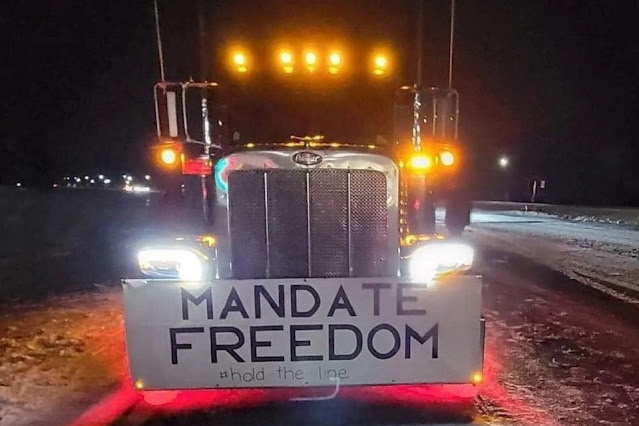
It’s possible that we’re living through a pivotal moment right now and yet Americans, and Michiganders in particular, appear to be sitting on their hands or twiddling their thumbs as freedom fighters across the bridge fight to reclaim their liberty. At long last, I think it’s time to start rallying around the cause. 

It’s now or never, because if it’s not now, it won’t be peaceful the second time around; if not now, there will always be another excuse for inaction. Those who don’t act now will be the bystanders to history, or worse its casualties. Too cowardly to join in the fight, they will hope and pray that freedom prevails, lest they live to regret their indifference to it all; lest they live to behold the future to which they’ve condemned their heirs. 

To what will this history attribute the failure of freedom in America? In this moment, it’s unequivocal: greed, cowardice and indifference. What a sorry excuse of Americans, and what a lousy way to forfeit so celestial an article as freedom. 

We cannot sit idly by as our allies take up the mantle in the reclamation of liberty. If ever there were a time to stand resolute in our convictions, and to reprise the Spirit of ‘76, that time is now! The seeds of liberty are sown by the few, yet the fruits are enjoyed by the many. Let us not fantasize about the possibilities, but let us write the history as it ought to be written. 

In the hallowed words of one Thomas Paine, these are the times that try men’s souls! These are the times that history is made! 

The summer soldier and the sunshine patriot will, in this crisis, shrink from the call of liberty and the service of their country; but he that stands by it now, who answers that most urgent call, deserves the love and thanks of man and woman. He is judged not only in his time, but for all of time in his most glorious sacrifice. Nothing, so long as man inhabits this planet, will ever be more important.

Tyranny, like hell, is not easily conquered; yet we have this consolation with us, that the harder the conflict, the more glorious the triumph. What we obtain too cheap, we esteem too lightly: it is dearness only that gives every thing its value. Heaven knows how to put a proper price upon its goods; and it would be strange indeed if so celestial an article as freedom should not be highly rated. 

We have it in our power to make the world over again; to reclaim our freedom along with our humanity; to honor the sacrifice of Patriots of prior generations; to sustain the memory, traditions and the spirit of America; and to preserve the blessings of liberty to ourselves and our posterity. Let us not allow it to slip through our grasp!

Comments

Popular posts from this blog

The Deal with Tariffs

Over the course of President Trump’s two terms, there has been much talk around the matter of tariffs — taxes on imported goods. However, much of the talk seems to miss the point. After all, for those of us who seek the truth, it’s not really a question of whether tariffs are ‘good’ but whether they are preferable to other kinds of taxes — assuming, of course, that taxes are the rule, as certain as the eventuality of death. First, let’s establish the theory: beyond the generic purpose of revenue generation for the state, the institution of tariffs ordinarily serves to  reduce (or discourage) imports by making them artificially more expensive, while encouraging domestic production by making domestic products more appealing on a relative price basis. In the realm of foreign affairs, tariffs are instituted or threatened in the course of international trade negotiations in order to signal dissatisfaction with existing trade barriers and to push for more favorable trade terms; or in ord...

Summarizing the “Separation of Church and State”

There is much confusion surrounding the concept of the “separation of church and state”; much of it likely born out of the steep secular decline in religious affiliation across recent generations, with particular emphasis among atheists and anti-deists.  While many have hastened to leverage this language (“separation of church and state”) in order to condemn or censure religious values — particularly those which are Christian — where they have carried influence in public life (i.e. prayer in schools, teachers covering lessons from the Bible, government representatives appealing to God, coinage bearing the words “In God We Trust”), the truth is that this “separation” was never expected to completely eliminate religious practice or religious sentiment from all matter of public life. In fact, religion was so deeply enmeshed in American life during the eighteenth and nineteenth centuries that the French magistrate and prison reformer Gustave de Beaumont, during his nine-month tour of A...

Rethinking “Forgiveness”

Forgiveness is often hailed as the ultimate moral virtue — a cleansing of the soul, a sign of spiritual maturity, and the first step toward healing fractured relationships. But in modern discourse, particularly in religious and pop-psychological circles, “forgiveness” has extended beyond the sensible, beyond etiquette, and beyond justice and useful application. The concept of “forgiveness” has been stretched far outside of the realms of that which is easy to “forgive”, that which is merely inconvenient or annoying, or relatively innocuous or insignificant, where “forgiveness” is merely part of tolerating people’s human shortcomings, their mistakes and  their accidents , or extending ‘mercy’ to those who’ve disrespected or “trespassed against us” (and have since offered sincere apologies and the necessary restitution). This reimagined kind of “forgiveness” has taken on a dangerously idealized form ignorant to or dismissive of the laws and limits of human nature and the potential imp...

Their Lives, Their Fortunes, and Their Sacred Honor

A  recent YouTube post by the political organization PragerU betrays the truth about the American Revolution. It goes as follows: “Britain spent a fortune defending the colonies in the French & Indian War. America’s response? Boycotts, protests, rebellion. Ingratitude that sparked a revolution.” This description of history is not just a reductive reframing of the issues; it is a crude and provocative statement insulting the intelligence of Americans who remember their history and disrespecting the men who staked everything in their noblest of causes during the American Revolution.  One commenter in the comments section even sided with PragerU, taking to task any who dares criticize the post: “Are you incapable of creating scenarios from the opposite side?” Unfortunately for this commenter, true history isn’t about “creating scenarios”; it’s about understanding what actually happened — the totality of the circumstances. So, let us do just that: let’s get straight to the fac...

Cullen Roche's Not So "Pragmatic Capitalism"

In his riveting new work Pragmatic Capitalism , Cullen Roche, founder of Orcam Financial Group, a San Diego-based financial firm, sets out to correct the mainstream schools of economic thought, focusing on  Keynesians, Monetarists, and Austrians alike. This new macroeconomic perspective claims to reveal What Every Investor Needs to Know About Money and Finance . Indeed, Roche introduces the layman to various elementary principles of economics and financial markets, revealing in early chapters the failed state of the average hedge fund and mutual fund operators  —  who are better car salesmen than financial pundits, Roche writes  —   who have fallen victim to the groupthink phenomenon, responsible for their nearly perfect positive correlation to the major indexes; and thus, accounting for tax, inflation, and service adjustments, holistically wiping out any value added by their professed market insight.  Roche also references popular stu...

The ‘Values’ Problem in the NFL

Every year, there is talk across the major sports leagues about which players are due for contract extensions and huge paydays. The chatter is seemingly endless, and it often seems to cast a shadow over the sports themselves — talking heads arguing and debating, insisting that so-and-so is going to ‘reset the market’ or so-and-so is demanding the ‘market rate’ for his position.  This is where the conversation goes awry, economically speaking.  The truth is that players  are not commodities: they are neither fungible nor interchangeable. Each player brings a distinct skill set, and each team operates within a unique scheme, meaning that each player’s value is situational rather than universal. There is, thus, no ‘market rate’ for any player or position; contracts exist in relation to each team’s particular situation, and every dollar spent on one player (in a salary-cap league) directly reduces the resources available for others — where ‘overspending’ in any case necessari...

Fischer: Tortured in the Pasadena Jailhouse (featuring the Morals of Chess by Benjamin Franklin)

Buy your copy today of  Fischer: Tortured in the Pasadena Jailhouse (featuring the Morals of Chess by Benjamin Franklin) , available at  Amazon  and Barnes & Noble . The name Bobby Fischer reigns supreme in the world of chess, yet there was a time when it hogged headlines, struck fear into the eyes of the competition, and was on the lips of folks all across the globe. More than the face of the centuries-old game, there was a time when Bobby Fischer was synonymous with the cause and spirit of America, that his moves on the chessboard sought more than checkmate but to pit the strength of “raw-boned American individualism” against “the Soviet megalithic system” which had come to dominate the game of chess at the same time it dominated Cold War politics. Fischer’s triumph over the USSR's Boris Spassky in the ’72 World Chess Championship would ultimately be celebrated as a symbolic and diplomatic victory for the U.S., but, as time would tell, it would not mean the American...

Death By Cop

A  recent post from a popular YouTube channel has provided more evidence of that which is blatantly obvious in modern America, at least to those who are willing to face the truth: the fact that cops, as with the governments they serve, are the enemy to goodness, justice, and American liberty.  This latest post is from The Civil Rights Lawyer, a channel (by a practicing civil rights lawyer) documenting police misconduct and civil rights violations since the year 2020. This time, it is a case of an elderly man, a former pastor suffering from dementia, murdered at the hands of “ the very people who were supposed to protect and care for him”: “Officers were dispatched to a business to assist an elderly customer who appeared to be suffering from dementia. At the scene, officers found him extremely confused. He told them the year was 1948 and that the president was George Washington. So they call his daughter to come pick him up. So how did things go so terribly wrong that day, tha...

The People's Banner: Why the “Thin Blue Line” Flag Betrays the Spirit of the Stars and Stripes

The American flag — proudly known as the Stars and Stripes — is more than a banner of colors stitched together. It is a living symbol of rebellion, unity, and the sovereignty of the people. It was never originally the flag of a government, but of a movement; not a mark of officialdom, but of revolution.  Having evolved from the Continental Union Flag, its stripes — with their roots in the "rebellious stripes" of the Sons of Liberty — represent resistance to abusive power, a stand against imperial overreach, and a declaration that legitimate authority flows from the consent of the governed. In this light, the proliferation of the “Thin Blue Line” version of the American flag is not merely a modification of a unique American symbol; it is a mutilation of the flag’s fabric and its meaning. It transforms a people’s flag into a government’s flag, in direct contradiction to its foundational ethos. The Stars and Stripes emerged during the crucible of the American Revolution. Designe...

“Stolen Land”

The claim that America was built on “stolen land” is not only a politically-loaded oversimplification, but a deliberately narrow framing that keeps America — and America alone — under perpetual moral scrutiny. It collapses fundamentally different actors, motives, and historical processes into a single accusation, thereby obscuring more than it explains. At a macro political level, land claims have  always  been in flux. Long before European contact, tribes across North America routinely warred over territory, resources, hunting grounds, and waterways. Claims were seasonal, contingent, and often overlapping, shaped by migration patterns, environmental conditions, and intertribal treaties that themselves shifted over time.  Had Europeans never settled in America, this dynamic would have continued to dominate; it was the prevailing condition of the continent. From this perspective, “ownership” has never been an abstract moral constant but a function of enforceability under a...